
The Missing Layer in AI
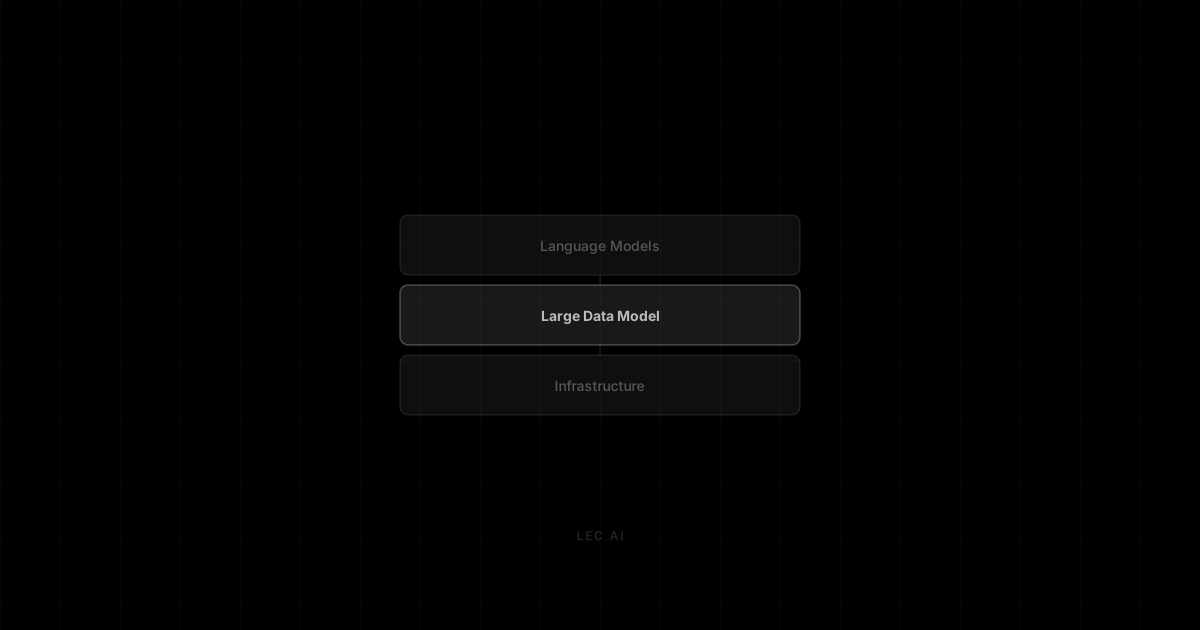
Large Language Models handle text. But businesses run on structured data — sales, operations, pricing, risk. The Large Data Model is the missing layer that makes AI commercially valuable.
Jack Perry
CEO, LEC AI
Everyone is talking about Large Language Models. They generate text, summarise documents, write code, hold conversations. The progress has been extraordinary.
But here is the problem nobody is addressing: businesses are not run on language. They are run on structured data. Sales figures, inventory levels, pricing tables, risk models, maintenance schedules, demand forecasts. The decisions that determine whether a company makes or loses money are overwhelmingly structured data decisions.
And right now, almost nobody is building the AI layer that handles them properly.
The Large Data Model
A Large Language Model takes text and predicts the next token. A Large Data Model takes structured datasets — sales, operational, pricing, risk — and predicts outcomes, identifies patterns, and surfaces decisions that would take teams of analysts weeks to find.
The distinction matters. When you feed a spreadsheet into an LLM, it converts numbers into tokens. It loses the variable relationships, the distributions, the temporal dependencies. It can describe what it sees. It cannot reason about it the way a purpose-built structured intelligence system can.
A Large Data Model understands that when SKU velocity in warehouse 14 drops below threshold while inbound lead time from the supplier extends, the correct action is to reallocate safety stock from warehouse 7 — not to write a summary about it.
Why This Matters Commercially
Every company of meaningful size has the same problem: slow, manual, incomplete structured decision-making.
- Forecasting that relies on last year plus a percentage
- Inventory managed by gut feel and quarterly reviews
- Claims and fraud caught after the fact, not predicted
- Maintenance scheduled by calendar, not by condition
- Pricing set by committee, not by market reality
These are not edge cases. They represent the core operational decisions that determine profitability. And in most companies, they are still made manually, slowly, and with incomplete information.
A Large Data Model can address up to 90% of these structured operational decision areas — delivering cost reductions of 40-60% through eliminating waste, reducing fragmentation, and surfacing decisions that humans simply cannot see at scale.
What It Actually Does Inside Companies
This is not theoretical. Here is what structured data intelligence looks like when deployed across industries:
Insurance and Reinsurance Catastrophe prediction models that price risk before it materialises. Fraud detection that identifies patterns across thousands of claims in real time. Underwriting accuracy that improves with every policy written. Capital allocation that responds to portfolio exposure dynamically.
Manufacturing Failure prediction that schedules maintenance before breakdowns occur. Quality variance detection that catches defects upstream. Downtime reduction through workflow pattern analysis. Yield optimisation across production lines.
Wholesale Distribution Consider a distributor with 35,000 SKUs, 61 warehouses, and 100,000 customers. Demand forecasting at the SKU-location level. Inventory optimisation that reduces working capital while improving fill rates. Route and allocation intelligence that compounds over time.
Mining and Heavy Industry Predictive maintenance scheduling for heavy equipment. Fleet coordination across sites. Production yield optimisation. Safety incident pattern detection.
Energy and Food Services Price forecasting for volatile commodity markets. Demand prediction that accounts for weather, seasonality, and market shifts. Waste reduction through consumption pattern analysis.
Why LEC AI Is Building This
At LEC AI, we have embedded the Large Data Model as a foundational layer — not a supplementary tool. Our architecture does not bolt structured intelligence onto a chatbot. It builds the organisational memory and reasoning capability from the ground up.
This is what allows Donnie’s executive cognitive model to operate on structured understanding, not just summarised text. When Donnie surfaces a deal risk or an operational bottleneck, it is reasoning about the underlying data relationships, not pattern-matching against language.
The intelligence compounds. Every decision outcome feeds back into the model. Every correction improves future predictions. This is what separates a depreciating tool from an appreciating asset.
Why Robotics Depends on This Too
There is a direct line between data intelligence and physical automation. Machines do not operate in isolation — they operate within workflows, supply chains, and operational contexts that are defined by structured data.
A robot on a production line needs to know more than its immediate task. It needs to understand demand patterns, quality thresholds, maintenance schedules, and upstream dependencies. That understanding comes from the data layer, not the language layer.
As LEC Group expands into industrial automation through LEC Industries, this convergence becomes critical. The companies that build both the intelligence layer and the physical execution layer will define the next generation of industrial capability.
Why the Market Has Not Fully Understood This
The market is fixated on the visible layer: chatbots, assistants, agents, copilots. These are valuable. But they are the surface.
Underneath, the structured data intelligence layer is what makes entire technology stacks economically viable. It is the difference between AI that impresses in demos and AI that transforms P&L statements.
The companies that recognise this early — and invest in building or deploying Large Data Models — will compound their operational advantage every quarter. The ones that wait will find the gap increasingly difficult to close.
This article was originally published on LinkedIn.